The Shore
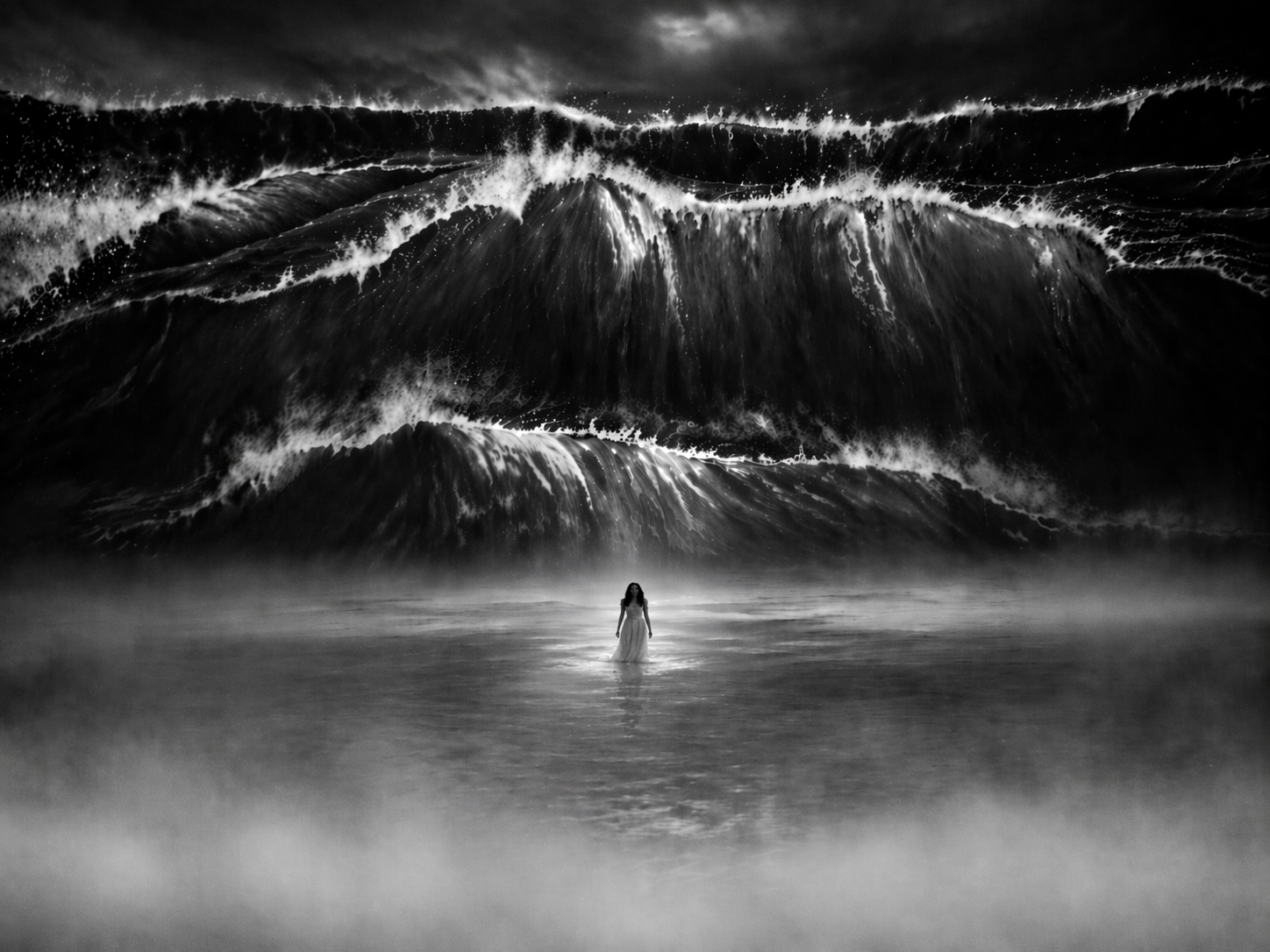
Grief is so unpredictable—it’s like standing in the ocean but facing the shore.
I’m not admiring the beautiful coastline as one would imagine. No, I am standing soaking wet—water dripping into my eyes, fists clenched, body shaking and tense. A permanent grimace is on my face. My knee and elbow are cut open, and a pink mixture of water and blood dissipates into the ocean surrounding me.
I am standing there waiting.
I am waiting for the next impact—the next wave to hit. In anticipation, I do my best to ground my feet by digging them deeper into the sand below me. I try my hardest to steady my body and brace for what I know is coming. It’s a futile effort at best.
I have no idea when it will hit or how big it will be. It might simply make me stumble or cause me to lose my footing for a moment. It might be tall enough to hit me square in the back—its impact causing me to break the surface of the water and go under for an instant. It also, however, could be one of those rogue waves that are big enough and strong enough to fully consume me—one of those violent and ominous-looking waves, where when it breaks, more white is visible than blue.
Each time this wave ruthlessly knocks the wind out of me and sucks me under to tumble uncontrollably in its core. It slams me violently against the rough ocean floor, causing my body to tear and bleed. Once the water retreats, I find myself on all fours—gasping for air, salt burning my eyes, a metallic taste coating my mouth. It takes all the energy and strength within me to stand—and once again—face the shore.
All around me are the silhouettes of those I love. It’s one of the worst parts. You see, I am not the only one struggling in these turbulent waters. My family is here too and I can hear their splashing, their struggle, and their cries for help.
They are near enough to see—just not close enough to touch. Time and time again I witness them get broadsided and sucked under. I strain my neck, squint my eyes, and hold my breath waiting for them to break through the water’s surface. I can see the pain and anguish on their faces, when they finally do. The same exhaustion. The same desperation. Blood drips from the tips of their fingers and disappears the instant it touches the water—one of the many sacrifices required by the ocean.
I scream their names. I reach for them—desperate to help, desperate to keep their heads above the waves. But my voice is cut short, as I’m sucked into the depths once again…
A friend’s phone rings and her screen reads, “Incoming Call—Dad.” I realize I will never see that screen again. My dad will never call me again—wave.
While driving home, my mom unexpectedly finds a piece of candy she had put in her purse weeks ago to give him as a treat. She looks at me and quietly places it back in her purse—wave.
I drive past the McDonalds where I would always buy my dad one of his favorite things—a quarter-pounder cheeseburger (plain of course)—wave.
I open my Find Friends app at work to see if my mom made it home safely. My dad’s name and number still sit below hers. Next to his name, it reads, “No Location Found”—wave.
I yell at the kids for being too loud and say, “Quiet guys! Papa is sleeping downstairs and you are going to wake…” The words stop abruptly once I realize the error in my statement—wave.
I instinctively set aside two pieces of cheese pizza before letting a swarm of hungry children come to the dinner table. I remember too late that he is gone and it’s no longer my job to make sure he gets dinner—wave.
“Mama, I don’t like it when people I love go to heaven.” My son sobs into his pillow uncontrollably before bedtime. There is nothing I can do to calm him or soothe his little broken heart—wave.
When clearing out my refrigerator, I find my dad’s mustard. His is the only one who liked it. It takes all my energy, and the breath from my lungs, to put it in the trash—wave.
I go downstairs to say goodnight to my mom. She is sitting still and alone on the side of her bed, wearing my dad’s slippers, with giant tears rolling off her cheeks—big wave.
An unanticipated text comes from my mom—“I’m on my way home with Dad.” She comes through the front door fifteen minutes later holding a box—rogue wave.
Sometimes the sets are on top of each other and sometimes they are more spread out. But one thing is always constant—the promise of the next wave. It’s a brutal cycle where all that is predictable is its unpredictability.
Eventually, the hurricane nature of these waters will begin to settle. In time, the clouds will break and the sun may even peak through. As the months and years pass, the waves will get a bit further apart and give us more room in between to dry off (and maybe even catch our breath). But for now—the storm is swirling black above us, the wind is whipping through our wet hair, and the waves are right on top of each other. Right now—it feels as though we may drown.
I have stood in this space before, no stranger to the violent nature of the ocean. I know that just as the waves never cease, that neither will my pain. But in time, I also know I will find a rhythm to these waters. It may be subtle, and far from dependable, but it is still there. While the ocean can never be fully understood or predicted, its tides have patterns—seasons when the waters rise with fury and others when they settle into a less volatile dance.
Grief is much the same. It may never leave, but I can learn when to brace for the storm above and when to look up at the warmth of the sun, close my eyes, and let my heart breathe.
Regardless of the passage of time, there will always be the threat of that rogue wave. I learned that lesson last time around. Whenever I thought I had finally understood the tempo of my new environment, it would hit. Unexpectedly. Violently. It would come without warning—regardless of my learned ability to ‘read’ the waters. Even when I was slightly acclimated to the ocean and gained muscle from standing my ground—this wave would completely consume me. It’s too big. Too strong. Too relentless to withstand. I know it will crash into my back, steal the breath from my lungs, and pull me into its blackness. When I finally find the surface, just as breathless, bruised, and bloodied as the very first time it hit, I am reminded that I will never be able to control these waters, regardless of how hard I may try.
Turns out, big waves can hit—even on sunny days.
Thankfully, there is a lifeline in these waters…
I can’t always see it, the way I want to see it, or feel it, the way I want to feel it—but some part of me is still acutely aware of its presence.
When I am standing and cannot see what is headed my way—it steadies me. When I am in the ocean’s depths, fighting for air and thrashing to find my way to the surface—it lifts me. When my body and lungs are burning and feel as though they want to stop fighting—it pulls me.
This lifeline offers hope, and without it—only darkness awaits.
You see—I am wearing a life jacket—a gift born of great sacrifice long ago. A gift that was placed over my head as a little girl, and clipped into place by loving hands with deep scars.
It doesn’t keep me from getting knocked over, doesn’t keep me from bleeding. It doesn’t stop the salt or its burn to my eyes and lungs. It doesn’t stop the surge of waves headed my way. But—it faithfully pulls me to the surface—even when I’m not sure which direction is up.
This landscape is overwhelming and scary, even with the promise of hope and heaven. But I know in my core, this is not the end of our story. Not even close. I know this life is temporary and we were built for eternity. I know in the end we will all be together and whole.
In the end—Jesus wins and so do we.
But until that day arrives, and equipped by the grace of God, we will continue to stand—and face the shore.